History Of Abacus
What is Abacus?
Abacus in today's time is an ancient calculating device having its roots in Asia since ages. Abacus is made of wood, metal or plastic rectangular frame with freely sliding 5 beads over vertical rods. These beads are parted by a at-least fixed horizontal bar where 1 bead over the vertical bar is placed above the fixed horizontal bar and the remaining 4 beads below the fixed horizontal bar. The beads above the fixed horizontal bar represent number 5 whereas other each of the 4 beads below represent number 1.
Any bead which moves towards the fixed horizontal bar gains value and when it moves away from the fixed horizontal bar losses value, which can be interpreted as 1 bead below the fixed horizontal bar moving towards the fixed horizontal bar means 1 on abacus and 4 beads below the fixed horizontal bar moving towards the fixed horizontal bar means 4 and so as the case with 1 bead above the fixed horizontal bar moving towards the fixed horizontal bar means 5. moving away from the fixed horizontal bar is -1, -4 or -5 as the number of beads may be. Vertical rods on Abacus are used to represent the place value of number. If the centre rod of Abacus is place of One's or Unit, the immediate next rod to the left is the place of Ten's and the immediate nest rod to the left of Ten's is Hundred's and so on and so forth for thousand, 100 Thousand, Million's etc. Learning the skills to operate Abacus can easily enable a person to perform Arithmetic Operations of Addition, Subtraction, Multiplication, Division, Square Roots, Cube Roots etc. with ease after practicing the methods. In the todays time children love learning this tool and through guided Abacus Training they even can imagine abacus in their photographic mental ability to perform rigid calculations even faster than anyone attempting it on a calculators or computer.
Abacus Math is method, which allows delivering the popular modern benefits of Abacus learning in structured way. Abacus Math is systematic skill development course for kids to learn to operate Abacus for calculations and gradual development of mental arithmetic skills by imaging abacus in ones mind. Abacus Math is an effective but slow learning course. It is important to ensure to keep the interest of kids intact in the course. So for the reasons a good Abacus Math Course is developed as a step by step progressive course which focuses initially on developing finger techniques of operating Abacus followed by methods of Addition & Subtraction with a mix of introducing new methods of calculations like Multiplication, Division, Percentages at such a right time that interest of kids learning the operation is maintained in a balanced way, that they stick to the course for completion.
Origin of the name Abacus
Abacus, a Latin word derived its name from a Greek word abakos, a Greek genitive form of abax which means a calculating-table. Abax is also considered to have a meaning of "table used for drawing for geometric figures that is sprinkled with dust or sand".
Some people of authority think that this abax is derived from an ancient word (Semitic), abaq the Hebrew word which means dust or from a Phoenician word abak which means sand.
At present, abacus, also known as counting frame, is a tool or a device which is made of wood or plastic that contains a frame that has freely-sliding beads on wire. | 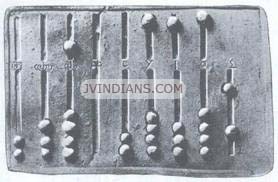 | |
| |
Predecessors of Abacus
Before the abacus was invented there are some counting devices that were used. The first counting device is the human hands which consist of ten fingers. As larger numbers were involved the ten fingers is not sufficient anymore to be used as a counting device. Man being resourceful used items like pebbles and twigs to help in counting larger numbers. The counting board, it is a counting device which is made of piece of stone, metal or wood that has carved grooves or lines that are painted within which the pebbles, metal discs or beads were moved. The Salamis Tablet is the oldest counting tablet that has been found. It was discovered in 1846 on the island of Salamis. This was used by the Babylonians approximately in 300 B.C. The Salamis Tablet is made of a slab white marble that had a measurement of 149cm which is the length, 75cm in width and 4.5cm in thick of which there were 5 groups of markings. At the center of the tablet there a set of 5 parallel lines that are equally divided by a vertical line, it was capped with a semi-circle at the intersection of the bottom-most horizontal line and the single vertical line. At the bottom of these lines there is a wide space with a horizontal crack dividing it. Under this crack is another group of eleven parallel lines, which is divided into two sections by a line perpendicular to them but with the semi-circle at the top of the intersection; the third, sixth and ninth of these lines are marked with a cross where they intersect with the vertical line. There are three sets of Greek symbols that are arranged along the left, right and at the bottom of the edges of the tablet.